
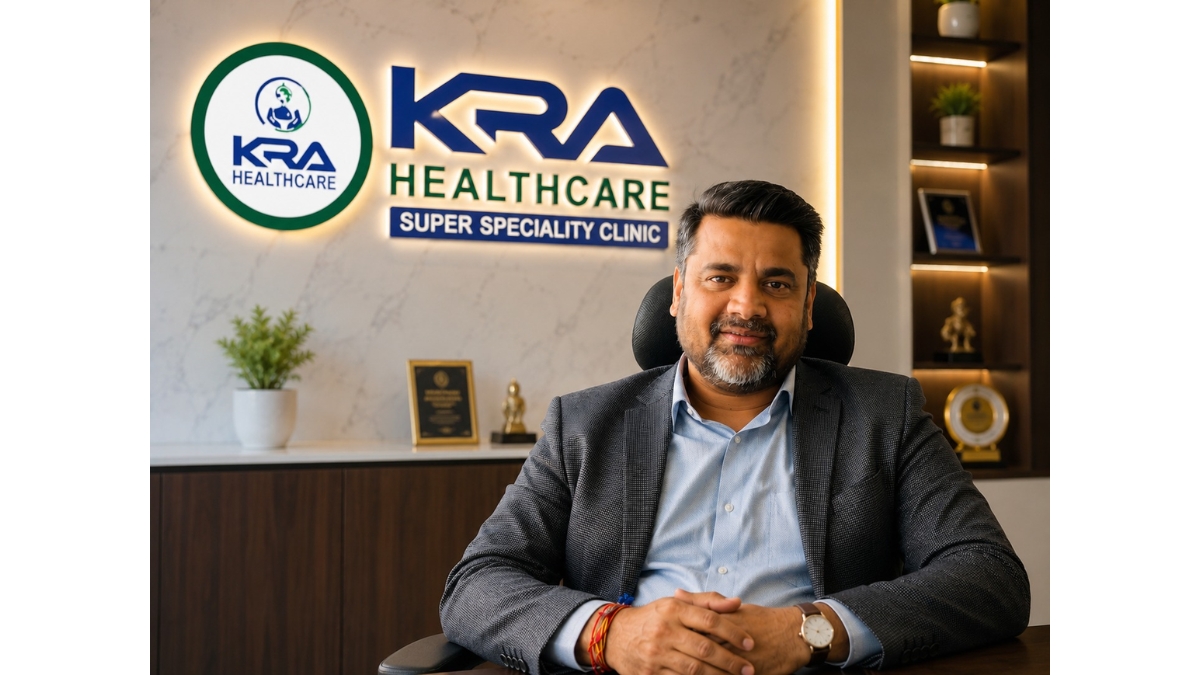
Director, KRA Healthcare
Healthcare has a peculiar way of exposing the cracks beneath even the most well-planned urban lifestyles. Gated communities may have surveillance systems, security personnel and world-class amenities, yet when a medical emergency strikes, preparedness often gives way to panic. It is this overlooked reality that has shaped KRA Healthcare‘s community-first approach under the leadership of its Founder, Ashish Srivastava. In an insightful conversation with journalist Sweta Singh, Srivastava speaks about the philosophy behind KRA Healthcare, the vision driving its Emergency Health Desk initiative, and why the future of healthcare lies not merely in treating illness, but in building resilient, medically prepared communities where timely intervention can make all the difference.
Q: Sir, thank you for sharing your time with us today. Can you tell us about KRA Healthcare and what inspired you to start this journey?
Ashish Srivastava:
KRA Healthcare was established with a simple vision—to make quality healthcare affordable, accessible, and accountable for every family. During my years in the corporate sector and social service, I witnessed many people struggling to receive timely medical care, especially during emergencies. This inspired me to build a healthcare system that doesn’t just treat illness but supports families throughout their healthcare journey.
Q: You have spent many years in corporate leadership. What inspired you to move into healthcare?
Ashish Srivastava:
For more than two decades, I worked in corporate management while actively participating in social welfare initiatives. During this period, I realized that healthcare is not just about hospitals—it’s about timely guidance, prevention, and access. Many medical emergencies become serious simply because help arrives too late. That realization motivated me to establish KRA Healthcare with a patient-first philosophy.
Q: KRA Healthcare is a multispeciality day-care centre. What makes your healthcare model different?
Ashish Srivastava:
We strongly believe that nearly 70–80% of medical conditions can be effectively managed through a well-equipped multispeciality day-care centre without unnecessary hospitalization. Hospital admissions should be reserved for critical cases. Our focus is preventive healthcare, specialist consultation, diagnostics, physiotherapy, mental healthcare, pharmacy, and coordinated treatment under one roof.
Our objective is to reduce unnecessary medical expenses while ensuring patients receive quality treatment at the right time.
Q: Recently, people have been talking about your Emergency Health Desk initiative. What exactly is it?
Ashish Srivastava:
The Emergency Health Desk is one of our most important community healthcare initiatives.
Today, residential societies have CCTV cameras, security guards, maintenance staff, and fire safety systems—but when a resident suddenly suffers a heart attack, stroke, fall, severe injury, or any other medical emergency, there is often no organized medical response mechanism.
Our Emergency Health Desk bridges that gap.
It acts as a dedicated healthcare coordination system inside the society that helps residents receive immediate medical guidance, ambulance coordination, hospital assistance, emergency support, and follow-up care. It is particularly valuable for senior citizens, children, pregnant women, and patients suffering from chronic illnesses.
Because during an emergency, every minute can save a life.
Q: Why do you believe every residential society should have an Emergency Health Desk?
Ashish Srivastava:
Modern societies invest heavily in infrastructure and security, but healthcare preparedness is often overlooked.
Medical emergencies occur without warning. Families frequently don’t know whom to contact, which hospital to visit, or how to arrange timely medical assistance.
An Emergency Health Desk provides residents with:
- Faster emergency response coordination
- Medical guidance during critical situations
- Ambulance and hospital coordination
- Support for senior citizens living alone
- Preventive health awareness programmes
- Better community health management
Healthcare should begin before reaching the hospital—not after.
Q: Will every society automatically receive this service?
Ashish Srivastava:
No. We strongly believe in transparency and community participation.
The Emergency Health Desk will be established only after approval by the Society’s Managing Committee and the General Body/AGM, in accordance with the society’s rules and regulations.
Our team first presents the complete proposal, explains the benefits, operational process, responsibilities, and commercial model. Only after formal approval do we implement the service.
We want every resident to feel confident that the initiative has been introduced with complete transparency and collective consent.
Q: Can you tell us about the One Family One Card (Family 360 Plan)?
Ashish Srivastava:
The Family 360 Plan has been designed to make quality healthcare affordable for every family.
For ₹20,000, members receive healthcare benefits worth ₹30,000 along with specialist consultations, discounts on diagnostics and medicines, complimentary health sessions, priority appointments, accident insurance benefits, and preventive healthcare support.
Our objective is simple—families should never delay treatment because of financial concerns.
Q: KRA Healthcare has been actively involved in community healthcare. Tell us about your social initiatives.
Ashish Srivastava:
Community healthcare has always been our priority.
We are proud to have served the National Association for the Blind (Dwarka) and worked with Rotary organizations on various healthcare initiatives. Our team regularly organizes awareness programmes, preventive health activities, senior citizen support initiatives, and community outreach services.
Healthcare should not be confined within hospital walls—it should reach every community.
Q: What message would you like to share with the residents of Dwarka?
Ashish Srivastava:
Healthcare is no longer just about treatment—it is about preparedness, prevention, and timely response.
Our vision is to build healthier residential communities where every family has quick access to quality healthcare whenever they need it.
Through our Emergency Health Desk initiative, Family 360 Membership, and multispeciality healthcare services, we hope to make quality medical care more accessible, affordable, and dependable.
Together, with the support of RWAs, residents, and community leaders, we can create safer and healthier neighbourhoods for everyone.
Why Every Society Needs an Emergency Health Desk
Key Benefits
- 24×7 Emergency Coordination Support
- Ambulance Assistance
- Hospital Coordination
- Senior Citizen Emergency Care
- Emergency Contact Management
- Preventive Health Awareness Sessions
- Health Records & Referral Support
- Priority Healthcare Assistance
- Community Health Programmes
- Resident Healthcare Guidance
For more information, visit: www.krahealthcare.com
(The article has been published through a syndicated feed. Except for the headline, the content has been published verbatim. Liability lies with original publisher.)